Invisalign vs Braces
Invisalign vs Braces: Which Is Right for You?
Invisalign (clear, removable aligners) suits mild to moderate crowding, spacing and bite issues for people who want a discreet, comfortable option and can wear aligners 20–22 hours a day. Braces (fixed brackets and wires) handle every case, including severe crowding and complex bite or jaw problems, and work 24/7 without relying on daily discipline.
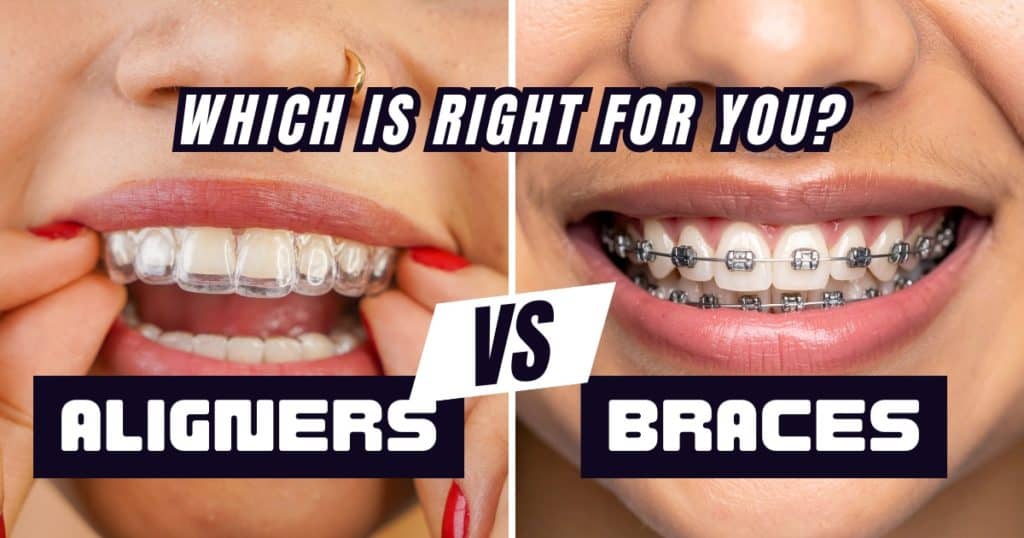
If you’ve been thinking about straightening your teeth, you’ve probably come across the two most common options, Invisalign and traditional braces. Both can help you achieve a confident, well-aligned smile, but they’re quite different in how they look, feel, and work. Invisalign uses clear, removable aligners that blend in with your teeth, while braces use metal or ceramic brackets fixed in place to gently move your teeth over time.
Deciding between them can be tricky. You’ll find plenty of opinions online: some swear by Invisalign’s comfort and invisibility, while others prefer the reliability of braces. So, how do you know which is right for you?
This guide simplifies the comparison so you can clearly understand how each option works, the pros and cons, and what kind of results you can expect, and make a confident, well-informed decision about your smile.
What Are Braces and Invisalign?
What Are Braces?
Braces are a traditional orthodontic treatment that uses metal or ceramic brackets, wires, and elastic bands to gradually move your teeth into proper alignment. They’re fixed to your teeth, meaning only your dentist can remove them. Common types:
Metal braces: the classic, most durable option.
Ceramic braces: tooth-coloured brackets that blend in better.
Lingual braces: attached to the inside (tongue side) of teeth, less visible.
Self-ligating braces: advanced brackets that don’t need elastic bands.
What Is Invisalign?
Invisalign uses a series of clear, removable aligners custom-made to fit your teeth. You wear each set for about 1–2 weeks before switching to the next one. The aligners gently shift your teeth into place without brackets or wires.
They’re nearly invisible, comfortable, and can be removed while eating, brushing, or during special occasions.
How Do Braces Work?
Braces are one of the most trusted and time-tested orthodontic treatments. They work by applying gentle, continuous pressure to your teeth through brackets, wires, and elastic bands. Over time, this pressure gradually moves your teeth into their ideal positions, correcting alignment, spacing, and bite issues.
Each tooth has a small bracket attached to its surface. A thin metal wire runs through these brackets, connecting them together. During your orthodontic visits, your dentist or orthodontist makes small adjustments to the wire’s tension, guiding your teeth step by step into a straighter position.
This process doesn’t just improve appearance; it also enhances your bite function, oral health, and overall facial harmony.
Braces Are Highly Effective For
✓ Severe crowding or spacing, even with limited space or large gaps
✓ Complex bite problems: overbites, underbites, crossbites, and open bites
✓ Jaw alignment issues, improving both function and aesthetics
Pros of Braces
✓ Suitable for all cases, from mild misalignment to complex bite issues
✓ Greater control: fixed braces allow high-precision movements
✓ No daily effort: braces work 24/7, nothing to remember
✓ Variety of options: metal, ceramic, lingual, and self-ligating
Cons of Braces
✗ Noticeable appearance (ceramic or lingual options reduce this)
✗ Food restrictions: sticky, hard, or chewy foods can damage brackets
✗ Harder to clean around brackets and wires
✗ Initial discomfort after adjustments, usually temporary
✗ Occasional mouth irritation; orthodontic wax helps
How Does Invisalign Work?
Invisalign straightens teeth with a modern, digital-first approach. Here’s how the process unfolds, step by step:
Initial assessment and 3D scan
Your orthodontist takes a 3D digital scan or impression of your teeth, creating an accurate virtual model to plan each tooth movement in detail.
Custom treatment plan
Specialised software maps out a series of incremental movements from your current position to the desired result. You can often preview the projected outcome before treatment starts.
Manufacture of aligners
A series of custom-made clear aligners is produced, each slightly different and designed to apply gentle pressure to move specific teeth bit by bit.
Wearing and switching aligners
You wear each aligner for about 1–2 weeks (your orthodontist will advise the exact timing), then switch to the next set.
Attachments and refinements (if needed)
Small tooth-coloured attachments may be bonded to teeth to give the aligner something to push against. Refinement aligners may be ordered for further fine-tuning.
Retention
Once active treatment is finished, retainers maintain the teeth in their new positions. Wearing retainers as instructed is crucial to keeping your results.
Pros of Invisalign
✓ Virtually invisible: discreet for adults and teens
✓ Comfortable and smooth: no metal rubbing on lips and cheeks
✓ Removable for eating and oral care, with no food restrictions
✓ Fewer in-office adjustments: mostly progress checks
✓ Predictable digital planning with a simulated “after” view
Cons of Invisalign
✗ Requires discipline: wear 20–22 hours a day or progress slows
✗ Not ideal for very complex cases such as severe bite or skeletal issues
✗ Aligners can be lost or damaged, causing delays or extra cost
✗ Possible slight lisp for the first few days
✗ Attachments may be visible on close inspection
Invisalign vs Traditional Braces: Which Works Faster?
Treatment time depends on the complexity of your case.
Invisalign
Typically 6–18 months
Braces
Usually 18–24 months
For mild to moderate cases, Invisalign may work faster because of controlled digital planning. For more complex orthodontic issues, braces can be more efficient.
Invisalign vs Braces Cost in Hyderabad
When comparing Invisalign vs braces cost, prices vary with case complexity, treatment duration, and the materials and technology used. Average ranges in Hyderabad:
While Invisalign has a higher price tag, many patients find it worth the investment for its comfort, flexibility, and discreet appearance, especially adults and professionals who value convenience and aesthetics.
Ultimately, the best option depends on your budget, treatment goals, and lifestyle. A consultation will help you understand which treatment offers the best value for your smile.
How the Treatment Processes Work
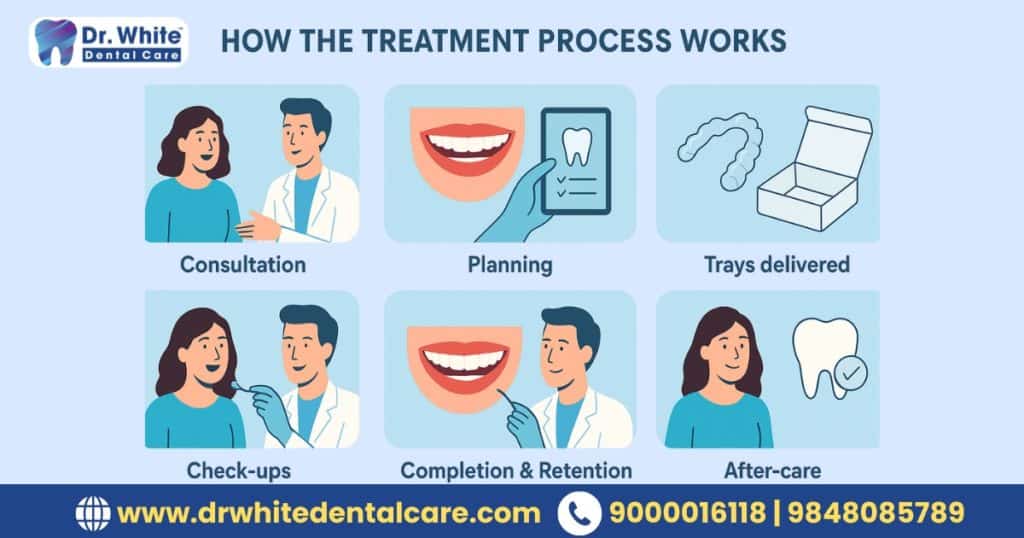
Clear Aligner Treatment Process
1. Consultation: scan and discussion at our Madinaguda or Nizampet clinic.
2. Planning: a digital model and preview of the expected movement.
3. Trays delivered: sets of aligners, changed every 1–2 weeks.
4. Check-ups: periodic visits to confirm teeth are moving as planned.
5. Completion & retention: a retainer holds your new smile.
6. After-care: good oral hygiene maintains results.
Traditional Braces Treatment Process
1. Consultation and scan or impression.
2. Brackets fixed to teeth, wires inserted, elastics if needed.
3. Adjustment visits every 4–6 weeks to guide movement.
4. Braces removed when finished; retainers maintain results.
5. Careful hygiene and no hard or sticky foods during treatment.
Oral Hygiene & Precautions
Whether you choose aligners or braces, maintaining good oral hygiene is critical.
✓ With removable aligners, take them out to brush and floss normally
✓ With braces, use interdental brushes or floss threaders around brackets
✓ Avoid sugary drinks and sticky foods that cause stains or decay
✓ Attend check-ups at our Madinaguda or Nizampet clinic to monitor progress
✓ Contact the clinic promptly if you have discomfort, loosening, or unusual pain
Who Is a Good Candidate for Invisalign?
For Adults
Discreet appearance: nearly invisible, ideal for working professionals.
Removable and comfortable: no food restrictions or metal irritation.
Requires discipline: must be worn 20–22 hours a day.
Best for mild to moderate cases: spacing, crowding, and minor bite issues.
Braces for complex cases needing significant movement or bite correction.
For Teens
Both options are effective for teenagers.
Invisalign Teen features: wear indicators help track usage, and extra replacement aligners are provided in case one gets lost.
Lifestyle-friendly: less risk of mouth injury in sports or music, and removable for school events.
Responsibility required: teens must wear and care for aligners consistently.
Braces advantage: work 24/7 for teens who might forget aligners, with more control for complex corrections.
Invisalign = best for adults and responsible teens who value comfort, flexibility, and aesthetics.
Braces = best for those needing stronger correction or a “no-maintenance” option that doesn’t rely on daily discipline.
Invisalign vs Braces: Which Is the Better Choice for Your Smile?
Invisalign vs Ceramic Braces
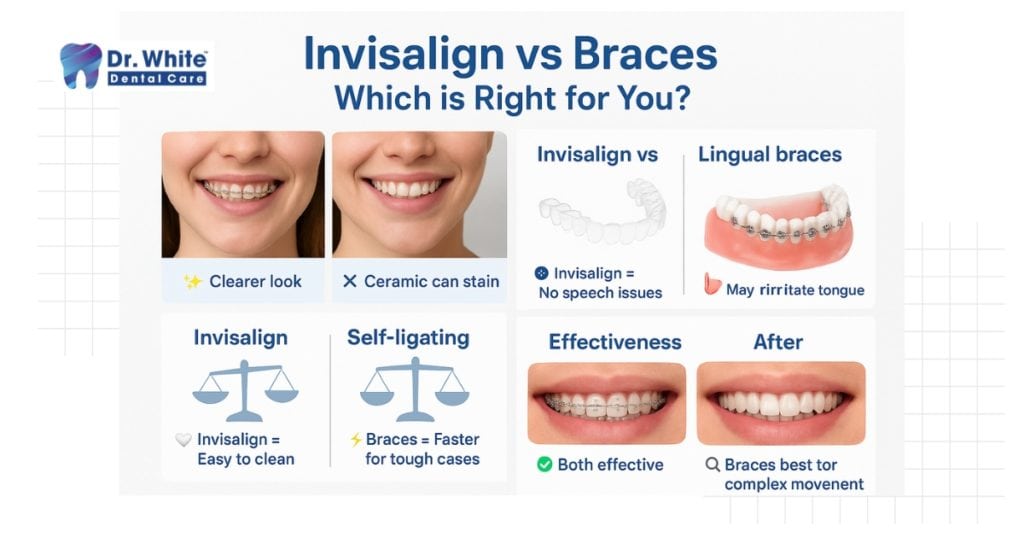
Ceramic braces are less noticeable than metal braces but still visible up close. Invisalign offers a completely clear look. Ceramic braces can stain if not cleaned properly, while aligners are replaced frequently.
Invisalign vs Lingual Braces
Both are discreet, but lingual braces can affect speech and cause tongue irritation. Invisalign aligners are generally more comfortable for daily wear.
Invisalign vs Self-Ligating Braces
Self-ligating braces reduce friction and treatment time. Invisalign wins on aesthetics and comfort, while self-ligating braces may be more effective for complex cases.
Invisalign vs Braces Effectiveness
Both are highly effective when used correctly. Invisalign uses 3D planning and SmartTrack material, making it reliable for many cases. Braces remain unmatched for complex movements and jaw corrections.
For most adults and teens seeking cosmetic alignment and improved confidence, Invisalign delivers excellent results with fewer disruptions to daily life.
Maintenance Tips for Invisalign and Braces
For Invisalign
✓ Clean aligners daily with a soft brush and mild soap
✓ Rinse after eating or drinking
✓ Store aligners in the case when not in use
For Braces
✓ Brush carefully around brackets
✓ Avoid sticky, hard foods (like caramel or nuts)
✓ Use an interdental brush or water flosser
Good oral hygiene keeps your teeth healthy throughout treatment.
Invisalign vs Braces: Key Differences
Final Thoughts
Both Invisalign and braces are highly effective orthodontic treatments that can help you achieve a healthy, well-aligned, and confident smile. Invisalign provides a nearly invisible, comfortable, and removable experience, while braces deliver precise results for even the most complex cases. The right choice depends on your individual needs, lifestyle, and treatment goals.
At Dr White Dental Care in Madinaguda and Nizampet, we believe every smile deserves a personalised approach. We use 3D digital scanning and customised treatment planning to make your aligner or braces treatment accurate, comfortable, and efficient.
Whether you’re an adult seeking a discreet option like Invisalign or a teen needing the reliability of braces, we’ll guide you toward the most suitable solution for your smile.
Not sure which is right for you?
Book a consultation to compare Invisalign and braces for your teeth.
Frequently Asked Questions About Invisalign vs Braces
Which is better, braces or Invisalign?
Both are excellent ways to straighten teeth. Invisalign is ideal for mild to moderate misalignment, offering comfort, convenience, and a nearly invisible look. Braces are better for more complex bite problems or severe crowding since they provide stronger control and continuous movement.
Why don’t some dentists recommend Invisalign?
Invisalign isn’t suitable for every case. It works best for mild to moderate alignment issues; severe crowding, large gaps, or significant bite corrections may need traditional braces. Experience also matters, so choose a clinic where an experienced dentist or orthodontist plans and monitors your case.
What are the negatives of Invisalign?
It requires consistent wear (20–22 hours per day), isn’t ideal for very complex bite issues, aligners can be lost or damaged, mild speech changes can occur for a few days, and it usually costs more than traditional braces. With proper discipline and care, most patients find these minor.
Can you eat with Invisalign in?
No, remove your aligners while eating or drinking anything except water. Eating with aligners can cause staining, cracking, or warping, and trap food particles. Always brush and rinse before putting them back in.
Can I still kiss with Invisalign?
Yes. The aligners are thin, smooth, and barely noticeable, so they won’t interfere.
What is the 30-minute rule for Invisalign?
Avoid keeping your aligners out for more than 30 minutes at a time, especially during meals. You need 20–22 hours of wear each day for the aligners to work effectively.
What is the failure rate of Invisalign?
Invisalign has a high success rate, around 96–98% when used correctly. Failures typically happen when patients don’t wear aligners as instructed or skip follow-ups. In rare cases, complex movements may need refinements or braces.
Can Invisalign change your face shape?
Subtly, yes. Aligning your teeth and improving your bite can make your smile more balanced, but Invisalign doesn’t change bone structure; the changes are about symmetry and aesthetics.
Why do dentists recommend Invisalign?
Because it’s almost invisible, comfortable and removable, gentle on gums and cheeks, digitally planned with 3D software, and usually needs fewer clinic visits than braces.
At what age does Invisalign stop working?
There’s no age limit. Adults in their 30s, 40s, and even 60s can benefit as long as their teeth and gums are healthy. Treatment may take slightly longer for older adults due to slower bone remodelling.
Who is a poor candidate for Invisalign?
Patients with severe bite or jaw discrepancies, teeth needing significant rotation or vertical movement, poor oral hygiene or gum disease, young children with baby teeth, and patients unlikely to wear aligners consistently.
Is 30 too late for Invisalign?
Not at all. Many people start Invisalign in their 30s or later. Teeth can be moved safely and effectively at almost any age.
What is the shortest amount of time you can wear Invisalign?
For mild spacing or crowding, treatment can take as little as 6 months. Most patients complete treatment in 6 to 18 months; your dentist can estimate your timeline after a 3D scan.