PFM vs Zirconia: Which Dental Crown Is Right for Your Smile?
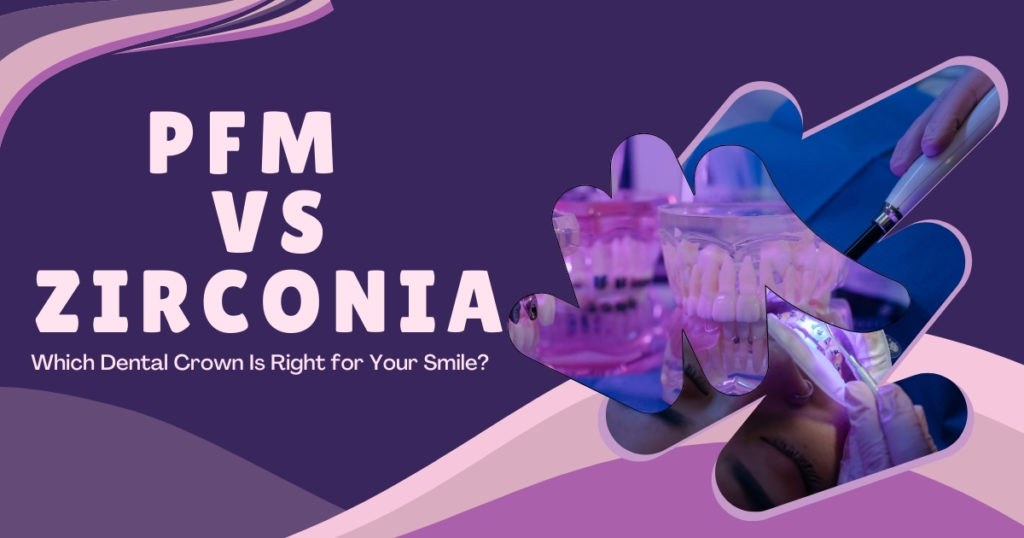
Dental crowns play a vital role in dental restoration, especially when a tooth is severely damaged, weakened, or has undergone a root canal. Acting as a protective cap, a crown covers the visible part of the tooth, restoring its shape, size, and function. PFM crowns are the strong, budget-friendly choice; zirconia crowns are metal-free, more natural-looking and usually last longer.
When it comes to choosing the right type of crown, patients often compare PFM vs zirconia, as both options are widely used in modern dentistry. Crowns are designed to add strength and stability to teeth that might otherwise be at risk of breaking, making them one of the most reliable long-term solutions for oral health.
Another key benefit is the durability of crowns. A well-made crown can last for many years, protecting the natural tooth underneath and preventing further damage or decay. Whether you need a crown for front teeth to improve aesthetics or for back teeth to handle heavy bite forces, crowns remain an essential treatment for oral health and confidence.
When Do You Need a Dental Crown?
Dental crowns serve more than cosmetic purposes; they play an important role in protecting and restoring teeth. Your dentist may recommend a crown in the following situations:
After a Root Canal Treatment
A tooth that has undergone a root canal is often weaker. A crown acts as a shield, covering the tooth and preventing it from cracking or breaking. For prices, see our guide to the root canal price in Hyderabad, including crown costs.
To Restore a Broken or Cracked Tooth
Teeth fractured due to injury, trauma, or heavy biting forces can be rebuilt with a crown, restoring both function and appearance.
When a Tooth Has a Large Filling
If more than half of the natural tooth is replaced by a filling, the remaining tooth may not be strong enough. A crown reinforces it and prevents further damage.
To Top a Dental Implant
When a dental implant is placed, a crown is fixed on top of it to mimic a natural tooth in both look and function.
To Support a Dental Bridge
Crowns are placed on the teeth next to a gap (abutment teeth) to hold a bridge in place when replacing one or more missing teeth.
For Cosmetic Improvements
Discoloured, misshapen, or worn-down teeth can be covered with crowns to enhance the smile. Zirconia crowns, in particular, offer lifelike translucency for front teeth.
To Protect Worn-Down Teeth
Teeth eroded by acid, grinding (bruxism), or age-related wear can be protected with crowns, preventing further breakdown.
To Strengthen Weak Teeth
Teeth with hairline cracks, weakened enamel, or a history of repeated dental work may benefit from the added stability of a crown.
What Are PFM (Porcelain-Fused-to-Metal) Crowns?
PFM crowns, also known as porcelain-fused-to-metal crowns, have been used in dentistry for more than 50 years and are still considered a reliable option for dental restoration. They combine the strength of a metal base with the tooth-coloured appearance of porcelain, balancing durability and aesthetics for both front and back teeth.
They became popular because they looked more natural than full metal crowns while still offering the strength needed for chewing. Even today, many dentists recommend PFM crowns for patients looking for a cost-effective way to restore function and appearance.
Anatomy of a PFM Crown
A PFM crown has two main components:
Metal substructure
The inner layer is made of strong metals such as nickel, cobalt, or gold alloys. This framework provides durability and helps the crown withstand daily biting and chewing forces.
Porcelain layer
The outer layer is porcelain, carefully shaped and shaded to resemble natural teeth, giving a more aesthetic look than all-metal crowns.
This combination of metal for strength and porcelain for looks made PFM crowns one of the most widely used types of dental crowns for decades.
Advantages of PFM Crowns
✓ Cost-effective: generally more affordable than zirconia crowns.
✓ Durability: the metal base gives long-lasting strength, especially for back teeth.
✓ Proven track record: trusted and widely used for decades.
✓ Versatility: suitable for single crowns, dental bridges, and complex restorations.
Disadvantages of PFM Crowns
✕ Gumline darkening: the metal can show as a dark line near the gums over time.
✕ Chipping risk: the porcelain may chip under heavy biting or grinding.
✕ Less natural look: less lifelike than zirconia, especially for front teeth.
✕ Possible allergies: some patients react to the metals used.
What Are Zirconia Crowns?
Zirconia crowns are one of the most advanced options in dental restoration today. They are made from zirconium dioxide (zirconia), a ceramic material known for its exceptional strength and biocompatibility. It is durable enough to handle strong chewing forces and attractive enough to closely mimic natural teeth.
Unlike older materials, zirconia is metal-free, which makes it suitable for patients with metal allergies or sensitivities. Its natural white shade and ability to blend with surrounding teeth make it especially popular with patients who prioritise aesthetics.
Evolution of Zirconia in Dentistry
When zirconia was first introduced, it was known mainly for its strength, but it was opaque and less natural-looking than porcelain. This limited its use to back teeth, where aesthetics were less critical.
Over time, dental technology improved, giving rise to translucent zirconia crowns. These keep the toughness of zirconia but let light pass through, much like natural enamel, making zirconia suitable for both front and back teeth.
Advantages of Zirconia Crowns
✓ Strength and durability: one of the strongest dental materials, resistant to chips and fractures.
✓ Biocompatibility: metal-free, gum-friendly, and less likely to cause irritation.
✓ Stain resistance: resists staining from tea, coffee, wine, or tobacco.
✓ Natural appearance: translucent zirconia offers excellent shade matching for front teeth.
✓ Longevity: with proper care, zirconia crowns can last 15–20 years or more.
Disadvantages of Zirconia Crowns
✕ Higher cost: the material and lab processes make zirconia more expensive than PFM.
✕ Needs digital lab work: zirconia crowns are usually designed and milled with CAD/CAM systems.
✕ Harder to adjust: its hardness demands precise preparation and fitting.
For patients who value long-term durability, natural aesthetics, and gum health, zirconia crowns are often the preferred choice, even at a higher initial cost.
PFM vs Zirconia: A Detailed Comparison
When patients search for the difference between PFM and zirconia crowns, they often want clear, side-by-side insights. Both materials are widely used in dental restorations, but they differ in appearance, strength, cost, and longevity:
PFM vs Zirconia for Front vs Back Teeth
Not all teeth have the same job. The front teeth are most visible and play a major role in your smile and speech, while the back teeth (molars and premolars) handle heavy chewing forces. So the right crown depends on where it will be placed.
Front Teeth (Aesthetics-Focused)
PFM: can look decent, but lacks zirconia’s lifelike translucency, and a dark gumline may appear as the metal shows over time.
Zirconia: modern translucent zirconia excels in shade matching, reflects light like enamel, and resists stains.
✓ Verdict: zirconia is the better choice when a natural smile is the priority.
Molars / Back Teeth (Strength-Focused)
PFM: the metal framework gives good strength, but the porcelain coating can still chip under heavy chewing.
Zirconia: highly resistant to wear and fracture, even with daily chewing and grinding, ideal where bite force is strongest.
✓ Verdict: zirconia outperforms PFM for molars thanks to its durability.
Maintenance & Care Tips for PFM vs Zirconia Crowns
Daily care
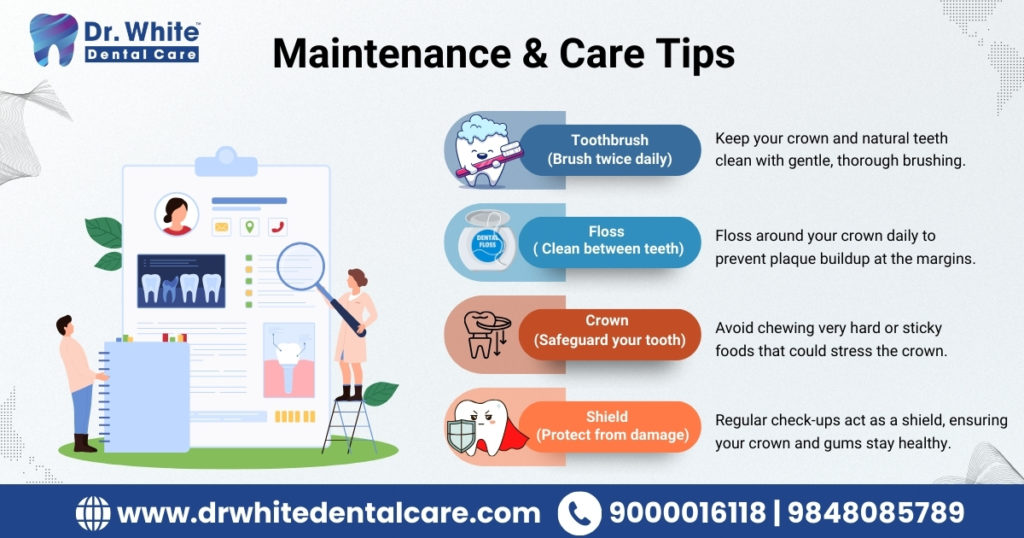
✓ Brush twice a day with a soft brush and non-abrasive toothpaste.
✓ Floss once a day; slide the floss out rather than snapping it up.
✓ Clean the gumline carefully, where decay can start on a crowned tooth.
✓ Consider a water flosser or interdental brushes if contacts are tight.
Diet and habits
✓ Avoid chewing ice, pens, fingernails, sticky toffees, or hard nuts on the crown.
✓ If you grind or clench, wear a custom night guard.
✓ Use a sports mouthguard during contact sports.
Products that help
✓ Fluoride toothpaste, or a dentist-recommended fluoride gel for high-risk patients.
✓ Alcohol-free mouthwash if your gums are sensitive.
✓ Desensitising toothpaste if the tooth is temperature-sensitive after placement.
Checkups
✓ See your dentist every 6 months for a cleaning and exam.
✓ Periodic X-rays check the tooth under the crown and the bone around it.
Temporary crown care
✓ Avoid sticky or hard foods on that side.
✓ Brush gently around the temporary and slide floss out sideways.
✓ Call your dentist if the temporary loosens or comes off.
Warning signs to call your dentist
⚠ The crown feels high, or your bite has changed.
⚠ Pain on biting, sensitivity that does not settle in a few days, or a crack or chip.
⚠ A loose crown, food trapping, swollen gums, or a bad taste that won’t go away.
Common Myths and Facts About PFM vs Zirconia Crowns
What to Expect During Crown Treatment?
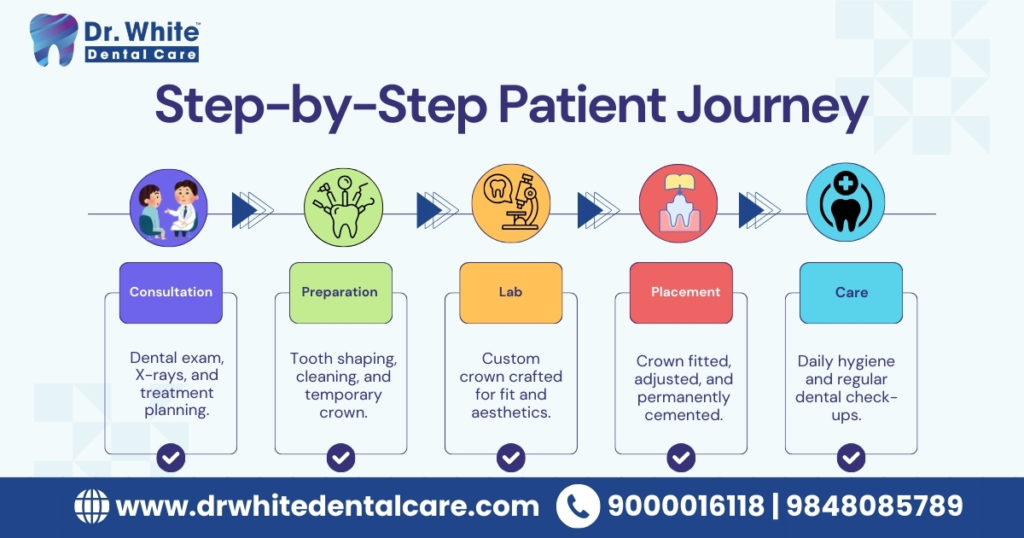
Getting a dental crown is a straightforward process. Here’s what typically happens:
Consultation and Planning
Your dentist examines the tooth with X-rays and photos to check for cracks, decay, or old fillings. You’ll discuss crown options (PFM vs zirconia) based on the tooth’s location, your bite, and appearance needs. The shade is chosen to match your natural teeth, and you’ll receive a clear cost estimate and treatment plan.
Tooth Preparation
The tooth is numbed for comfort. Any old filling or decay is cleaned, and the tooth is shaped to make room for the crown, with a build-up added if needed. An impression or scan is taken, and a temporary crown protects your tooth until the final one is ready.
Crown Fabrication
The dental lab designs your custom crown for a precise fit. This usually takes 1–2 weeks, depending on the crown type.
Final Placement
The temporary crown is removed and the permanent crown is tried in to check the fit, bite, and colour. Once everything looks and feels right, it is securely cemented in place.
Aftercare
Mild soreness or sensitivity is normal for a day or two, and sensitivity to hot or cold usually improves within a week. Avoid very hard or sticky foods right after placement, and contact your dentist if the crown feels high, loose, or uncomfortable.
Faster options: in some cases, crowns can be designed and made more quickly using digital (CAD/CAM) technology. Your dentist will let you know if this is suitable for you.
Types of Dental Crowns and Cost
One of the most common questions patients ask is: “What is the cost difference between PFM and zirconia crowns near me?” The answer depends on the crown material, the technology used, and the dentist’s experience. At Dr White Dental Care, we make sure patients receive clear, transparent pricing and the right guidance for their needs.
PFM Crown Cost in Madinaguda & Nizampet
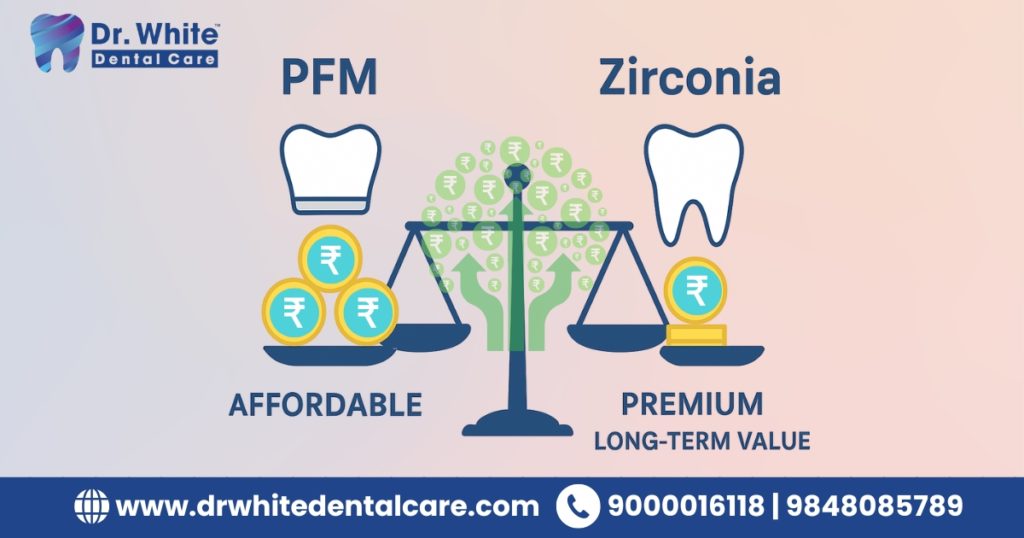
✓ Affordable choice: PFM crowns are generally the more budget-friendly option.
✓ Patients looking for affordable PFM crowns in Nizampet often choose them because they restore strength and function without a heavy price tag.
✓ However, PFMs may need replacement sooner than zirconia, especially if aesthetics are a priority.
Zirconia Crown Cost in Madinaguda & Nizampet
✓ Premium option: zirconia crowns usually cost more because of the material and digital lab work involved.
✓ Patients looking for zirconia crowns in Madinaguda often choose them for durability, lifelike aesthetics, and gum-friendliness.
✓ While the upfront investment is higher, zirconia crowns often last longer, making them cost-effective over time.
PFM vs Zirconia Cost Near Me
If you’re comparing PFM vs zirconia crown cost near me, here’s the quick breakdown:
• PFM crowns = affordable and reliable, but less aesthetic.
• Zirconia crowns = higher initial cost, but better longevity and a natural look.
At Dr White Dental Care in Madinaguda and Nizampet, we provide both options so you can decide based on your needs, budget, and long-term goals. Our dentists guide you step by step to choose the right crown for your smile, whether that’s budget-friendly PFM crowns in Nizampet or zirconia crowns in Madinaguda.
Future of Dental Crowns: What’s Next?
Dentistry is constantly evolving, and dental crowns are no exception. As patients look for stronger, safer, and more natural-looking options, researchers and dental professionals are pushing the boundaries of technology and materials.
Advances in Dental Materials & Digital Dentistry
High-performance ceramics
Newer zirconia and other ceramics are being engineered to combine strength and translucency, so crowns look even more natural while staying extremely durable.
Digital dentistry
With CAD/CAM systems, crowns can be designed and milled with high precision, which shortens treatment times, improves fit, and can reduce the number of visits.
3D printing
The dental industry is also exploring 3D-printed crowns, which could make future restorations faster and more affordable.
These advancements aim to make dental restoration not only more efficient but also more customised for each patient.
Ongoing Research on Zirconia’s Long-Term Outcomes
Clinical evaluation of zirconia
Studies so far show zirconia crowns perform well over the long term, and researchers continue to study their behaviour in different types of patients.
Gum and tissue response
Because zirconia is highly biocompatible, research is looking at how it interacts with gums over decades. Early results suggest healthier tissue response than metal-based options.
Durability under stress
Researchers are testing zirconia crowns under extreme bite forces to better predict outcomes for patients who grind their teeth or need large bridges.
The future looks bright: patients can expect stronger, longer-lasting, and more natural-looking results than ever before.
Conclusion
Choosing between PFM vs zirconia crowns comes down to balancing your needs for aesthetics, strength, cost, and long-term results. PFM crowns remain a reliable, affordable choice for many patients, especially for back teeth where strength is the priority. Zirconia crowns offer natural beauty, superior durability, and excellent biocompatibility, making them the preferred option for visible front teeth and long-lasting restorations.
The key takeaway? There’s no one-size-fits-all answer. The best crown for you depends on your smile goals, dental health, and budget. That’s why it’s important to get a personalised consultation with a trusted dentist who can guide you through the decision.
At Dr White Dental Care in Madinaguda and Nizampet, we offer both affordable PFM crowns and zirconia crowns. Whether you’re looking for a natural-looking option for your front teeth or a durable solution for your back molars, our team will recommend what truly suits you best. Learn more about our dental crowns and bridges in Hyderabad.
Not sure which crown is right for you?
Book a consultation and we’ll help you choose between PFM and zirconia.
Frequently Asked Questions About PFM vs Zirconia Crowns
Is PFM better than zirconia?
Both have pros and cons. PFM is durable and affordable, while zirconia is stronger, more natural-looking, and metal-free. The best choice depends on your tooth, bite, budget, and aesthetics.
What are the disadvantages of PFM crowns?
They may show a dark line near the gums, the porcelain can chip, and they are less natural-looking than zirconia crowns.
What is the cost of PFM vs zirconia crowns?
PFM crowns are generally more affordable, while zirconia crowns cost more due to their strength, aesthetics, and metal-free composition. The exact price varies by clinic, location, and case complexity.
Which crown is best for molar teeth?
Zirconia crowns are usually preferred for molars because they are extremely strong, fracture-resistant, and handle heavy chewing forces, while PFM crowns are also a reliable and cost-effective option.
Which crown is best for front teeth?
All-ceramic or zirconia crowns are best for front teeth because they provide superior aesthetics, natural translucency, and blend seamlessly with your smile.
How long do PFM crowns last?
With good oral hygiene and regular dental check-ups, PFM crowns usually last 10–15 years, though they may need replacement sooner if the porcelain chips or the gums recede.
Which tooth cap is best in India?
Zirconia crowns are widely considered the best for their strength, natural look, and metal-free design, for both front and back teeth. PFM crowns remain a popular, more affordable option, so the right choice depends on tooth position, budget, and aesthetic needs.
Which is better, a ceramic or a zirconia crown?
Both are good options. Ceramic crowns provide excellent aesthetics and are ideal for front teeth, while zirconia crowns are stronger, more durable, and suitable for both front and back teeth. The best choice depends on the tooth’s location, your bite, and cosmetic needs.
Do dentists still use PFM crowns?
Yes. Dentists still use PFM crowns because they are strong, reliable, and cost-effective, especially for back teeth and dental bridges. However, zirconia and all-ceramic crowns are now preferred for front teeth due to their superior aesthetics.
Why choose PFM or zirconia?
Choose PFM crowns if you want a strong, reliable, and budget-friendly option, especially for back teeth. Choose zirconia crowns if you want superior strength, a natural-looking smile, and a metal-free, long-lasting solution.